
The Surprising Reason Your Anxious Child Needs You to Come to Therapy
It’s not what you think. Our SPACE trained Child and Family Therapists give parents tools to treat child anxiety at home.
You've tried everything.
You've taken the long way to avoid the thing that sets them off. You've prepped them for every transition, packed their favorite items, and quietly rearranged the entire family's schedule around what might happen. You've talked them down, held them through it, and stayed up way too late because bedtime has become its own special kind of chaos.
And you're exhausted. Not just tired — exhausted in that bone-deep way that comes from loving someone really hard and still feeling like you're losing.
Here's what no one tells you: the reason nothing is working might not be about what your child is doing. It might be about what you're doing in response — and that's actually very good news.
There's a clinically proven approach called SPACE treatment — Supportive Parenting for Anxious Childhood Emotions — and it was built specifically for families like yours. The surprising part? Your child doesn't have to be the one in therapy. You do.
What Is SPACE Treatment?
SPACE is an evidence-based treatment for childhood anxiety developed by researchers at the Yale Child Study Center. It's been studied, tested, and refined — and it works.
What makes SPACE different from most approaches to child anxiety is this: instead of putting your child in the therapy chair and hoping the skills transfer home, SPACE works directly with parents. You learn a specific set of skills and strategies, and then you use them in the relationship you already have with your child. The therapist is more of a coach and consultant. You are the expert on your family.
The result? Your child's anxiety improves — because you change how you respond to it.
SPACE is effective for children across a wide age range, from young elementary-age kids all the way through teenagers. If anxiety has taken up residence in your home, SPACE is worth knowing about.
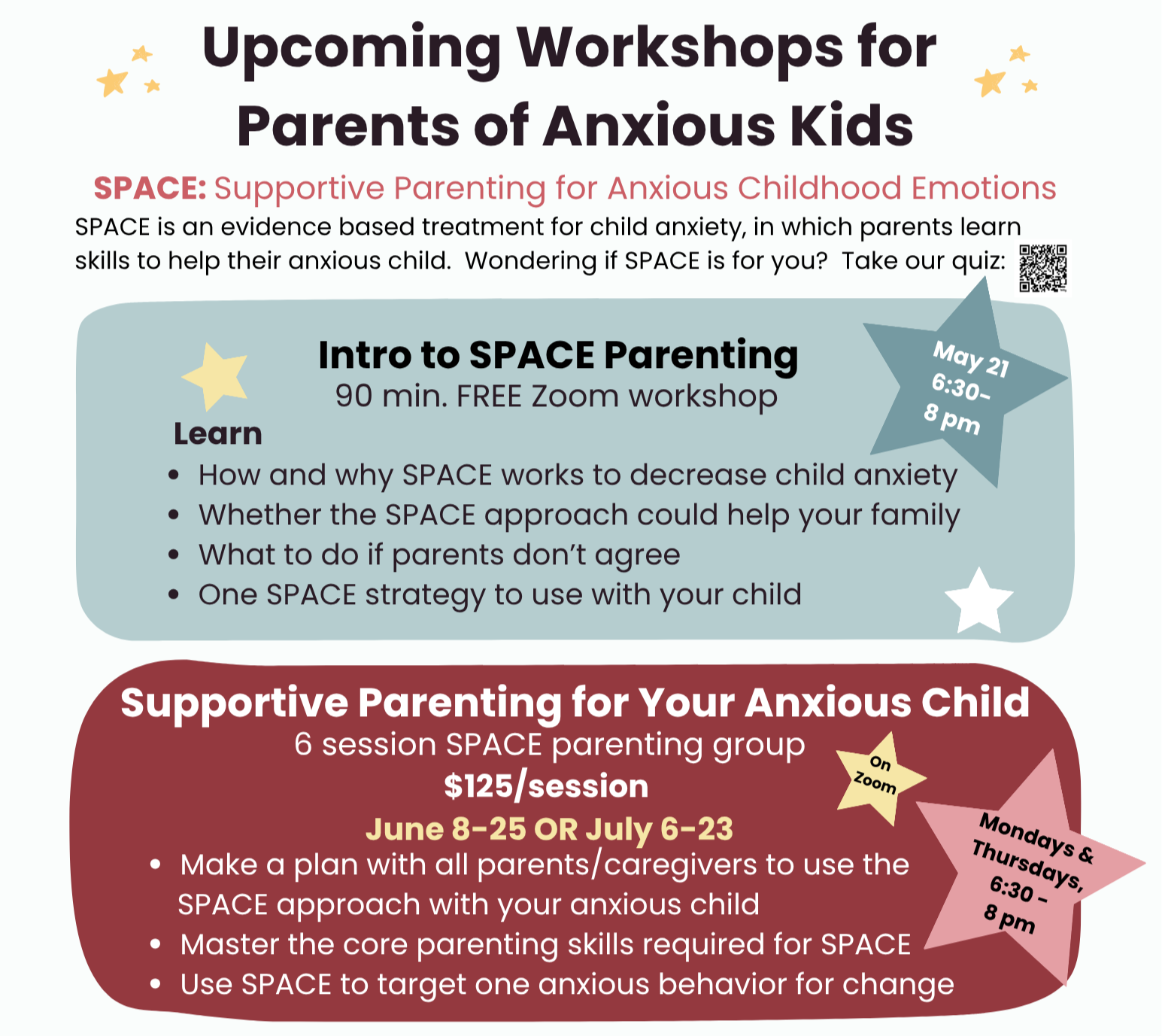
GREAT NEWS: We’re offering a FREE Intro to SPACE Workshop for Parents on May 21 at 6:30pm
The Thing Most Parents Don't Realize
Here's the part that's hard to hear, and also the part that changes everything:
When you have an anxious child, you love them. You see them struggling, and every parenting instinct you have says protect them. So you do. You prepare, you plan, you smooth the path. You wash your hands before every hug because Tyler needs you to. You take the long way to school. You stay until they fall asleep, even when it takes two hours.
This is called accommodation — and it makes complete sense. You're not doing anything wrong. You're doing what loving parents do.
The problem is that accommodation, as kind and well-intentioned as it is, accidentally teaches your child that the thing they're afraid of really is dangerous. Every time we rearrange our lives around their fear, we send a message: you were right to be scared. And the anxiety grows.
The toughest part of SPACE for many parents is learning to step back and let their child figure out that they're actually safe. It's counterintuitive. It tugs at every heartstring you have. And it's genuinely hard. But it's also where the change happens.
What SPACE Treatment Looks Like (and Doesn't Look Like)
Let's clear up a few things that often surprise parents when they first hear about SPACE.
Your child doesn't have to be in the room
SPACE treatment is done with parents. Your child doesn't need to attend sessions or meet with a therapist for SPACE to work. We do like to have an initial orientation session where both parents and child come together so everyone understands what's happening — but the ongoing work is yours.
Both parents (or all caregivers) can participate
We actively encourage all adult caregivers to participate in SPACE together. You'll be using these skills in your everyday life with your child, and it helps enormously when everyone in the household is working from the same playbook. Sessions are priced per family, not per person.
It isn't couples therapy or family therapy
SPACE isn't designed to solve problems between parents, and it doesn't address sibling dynamics. It's focused on the parent-child relationship and the specific patterns that have developed around your child's anxiety. Do we work with the differences that come up between you as you respond to your child’s anxiety? Absolutely! But if you’re feeling out of sync and want some support for your couple relationship, our couples therapists would be happy to help before you try SPACE treatment. And if sibling squabbles are a struggle, consult a family therapist to decide whether to address those too.
This isn't about blame
Your child's anxiety is not your fault. You didn't cause it. But just like you handle other things you didn't cause — tough teachers, friendship drama, skinned knees — you can absolutely be part of helping your child through this. SPACE gives you the tools to do exactly that.
How the SPACE Process Works
SPACE follows a clear arc. Here's the general shape of how it unfolds:
First, you learn. SPACE begins with education — about how childhood anxiety works, why it looks the way it does, and what's actually happening in your child's nervous system when they're in the middle of a meltdown. (Spoiler: it's nearly impossible to reason with someone whose fight-or-flight response is fully activated. This is even more true for kids, who don't yet have the emotional development to understand why they feel unsafe — they just do.)
Then, you identify the patterns. You and your therapist look at the specific accommodations you've been making — the things you do differently for this child that you wouldn't do for another child, or that you wouldn't have done before the anxiety took hold. You make a list. No judgment. Just honesty.
Then, you pick a target. Together, you identify which accommodation, if it changed, would make the biggest difference in your family's daily life. That becomes the focus.
Then, you prepare. Before anything changes at home, you work carefully with your therapist to craft a statement for your child — something empathic, clear, and supportive — that lets them know what's going to be different and why. This step gets a lot of attention, because how you deliver this matters.
Then, you implement. You begin making the change, using what SPACE calls supportive statements to help your child feel safe even as the accommodation is removed. You meet regularly with your therapist to review what's working and troubleshoot what isn't.
And then something shifts. Your child starts to discover that they can handle more than they thought. And so do you.
How We Offer SPACE at Better Together Family Therapy
Our team includes four SPACE-trained clinicians, all trained directly by the experts at the Yale Child Study Center. We offer SPACE in two formats so you can find the approach that fits your family.
One-on-One SPACE Therapy
Families can work with a SPACE-trained therapist individually, just like any other therapy service. This is a good fit if your situation is complex, you have specific scheduling needs, or you prefer a more personalized experience. Individual SPACE treatment typically runs 8–12 sessions.
SPACE Parenting Groups
We also offer SPACE in a small-group format — and this is something we're really proud of.
Groups consist of 6 sessions of 90 minutes each, all held on Zoom, with no more than 6 families per group. When a group reaches 6 families, two therapists lead the sessions. The small size is intentional — you'll actually have your questions answered, not just sit in a webinar.
Between sessions, families work on tasks at home, which is where the real learning happens.
The group format means you'll pay less than you would for individual sessions — and you'll be in the room (virtually) with other parents who get it. Parents who have also rearranged their lives around their child's anxiety. Who have also felt the guilt and the exhaustion and the "I don't know how much longer I can do this." That part isn't nothing.
We start every group experience with a free introductory workshop, so you can get a feel for the approach before committing.
Sign up for our free SPACE introductory workshop
One Thing We Ask Families to Commit To
If you decide to try SPACE, there's one thing we ask: while you're learning it, commit fully to this approach.
That means setting aside the other books about child anxiety for now. Not because they're bad, but because SPACE works best when you're not mixing and matching strategies. Pick it up again after — but while you're learning SPACE, give it your full attention. The families who see the biggest changes are the ones who go all in.

The Benefits Keep Growing
One of the things we love most about SPACE is what happens after the formal treatment ends.
Once you've learned the skills, you own them. You can apply the same framework to new challenges that come up — a new fear, a different child in the family, an anxiety flare during a stressful season. The approach becomes part of how you parent, not just a one-time intervention.
SPACE truly changes how parents handle anxiety. Which changes how children experience it. And once that shift happens, it tends to stick.
Is SPACE the Right Fit for Your Family?
SPACE works well when anxiety is showing up in your daily life — at bedtime, at school drop-off, at family gatherings, around food, around transitions, around anything that requires your child to tolerate uncertainty. If you've been accommodating your child's fears and it hasn't been helping, that's a strong signal that SPACE is worth trying.
Not sure if it's the right fit? We've put together a short quiz to help you figure that out.
You Don't Have to Keep Doing This Alone
Parenting an anxious child is one of the harder things a parent can face — not because you're doing it wrong, but because it's genuinely hard. Your child's fears are real to them. Your love for them is real. And the patterns you've fallen into made sense at the time.
SPACE gives you something different: a clear process, a supportive therapist (or a group of parents who understand exactly what you're living with), and skills you'll use for years.
You've been managing this for a long time. There's another way forward. Try SPACE treatment today.
Better Together Family Therapy offers SPACE treatment in Maryland, available in-person and online. Our SPACE-trained clinicians work with families of children from preschool age through young adulthood.
