
Family Estrangement and Reconciliation: A Neurodiversity Affirming Guide
Family estrangement touches more homes than most people realize — recent surveys suggest that somewhere between a quarter and nearly 40% of American adults have lost contact with an immediate family member at some point. If you're navigating distance from a parent, sibling, or adult child right now, you are not alone, and you are not broken.
As a practice offering Neurodiversity Affirming Therapy in Bethesda, MD and Counseling in Silver Spring, we sit with families working through estrangement often — and we've noticed that neurodivergent clients and their families face some particular versions of this struggle. This post walks through what estrangement actually is, how it's different from related concepts like disengagement and boundary-setting, what the research says about reconciliation, and some concrete communication tools you can start using today.

What Is Family Estrangement, Really?
Family estrangement researcher Kristina Scharp, PhD, defines it as an intentional distancing between family members driven by a negative relationship — or the perception of one. Importantly, her research shows estrangement isn't a single event or an on/off switch. It's a continuum. Some people are more estranged (rare or no contact) and some are less estranged (regular contact that stays surface-level to avoid conflict). Both count.
What makes it estrangement rather than "just an argument"? A few things:
It's ongoing, not a single blow-up. Most estrangement follows a long history of strain, not one incident (though sudden ruptures — like a parent's rejection after a child comes out — do happen).
It involves intent. Someone is choosing distance, not just drifting apart geographically or losing touch.
The relationship's basic roles have broken down. Researchers call this "role reciprocity" — the expectations that come with being a parent, sibling, or child are no longer being met or agreed upon.
A boundary, by contrast, is usually a tool within a relationship that's still functioning — a way of staying connected while protecting your wellbeing. Estrangement is what can happen when boundary-setting hasn't been enough, or wasn't respected.
Is Family Estrangement Different From Intentional Disengagement?
This is a distinction worth sitting with, because the two terms get used almost interchangeably — and they're not quite the same thing.
Disengagement can describe what's happening in a single interaction, or across a much broader stretch of time. In Scharp's model of estrangement, disengagement lines up with the presence or absence of emotion component — one of eight dimensions along which a relationship can move toward or away from estrangement.
In the psychological literature more broadly, disengagement describes the emotional quality of contact between people, or within a family system — not necessarily whether contact is happening at all. It's a "you can't affect me" stance. Someone can be fully present at Thanksgiving dinner and completely disengaged — passive, checked out, emotionally unreachable.
You could think of it as the internal cousin of estrangement's external distance: estrangement is often about reducing or ending contact; disengagement is about withdrawing emotional responsiveness, sometimes while contact continues uninterrupted.
This matters clinically because disengagement can be a precursor to estrangement, a coping strategy during estrangement, or, honestly, a healthy and appropriate response to an unsafe or exhausting dynamic. It isn't automatically a problem to solve — sometimes emotional disengagement is exactly what protects a person's nervous system while they figure out what they need.
Estrangement, Neurodivergence, and Family Relationships
This is where our neurodiversity affirming lens feels especially relevant. Research on autistic adults has found that a substantial number report estrangement from family, and the reasons most frequently cited aren't really about the neurodivergence itself — they're about the family's response to it. Refusal to accept a diagnosis, ongoing pathologizing of autistic traits, and relationships that required constant masking as "the price of admission" show up again and again in this research.
Put simply: many autistic adults don't become estranged from their families because they're autistic. They become estranged because staying connected required disappearing.
If you're autistic and estranged from family (or in conflict that's heading that direction), a few things are worth naming clearly:
Masking is not a sustainable long-term strategy for maintaining a relationship. If contact with a family member consistently requires you to suppress stimming, force eye contact, or perform neurotypical social scripts, that cost accumulates — and burnout, resentment, or eventual estrangement are common outcomes, not personal failures.
A family's reaction to your diagnosis (whether it came in childhood or adulthood) tends to predict a lot. Families who move toward neuro-affirming practices — adjusting expectations, learning about sensory needs, believing your reported experience — tend to stay more connected. Families who treat autism as something to manage or minimize tend to generate more distance over time, sometimes because the autistic family member chooses it, sometimes because it's simply unsustainable to keep trying.
If you are the parent or family member of an autistic person and you're feeling the distance grow, it's worth asking honestly whether your relationship has been asking your family member to mask in order to belong. That's a hard, vulnerable question — and it's often the actual hinge point in whether reconciliation is possible.
Undiagnosed neurodivergence in a parent can complicate things further. A parent who is themselves autistic or ADHD (diagnosed or not) may genuinely struggle to recognize their child's experience as different from their own, having never had their own needs named or accommodated either. This isn't an excuse, but it can be useful context for understanding — without excusing — how invalidating patterns got established.
If this describes your family, our Neurodiversity Affirming Therapy in Bethesda, MD services are built specifically around this kind of work — helping neurodivergent individuals and their families understand each other's experience without asking either side to disappear.
Can Estranged Family Members Reconnect and Heal?
Good news: they often do. Most estrangements are not permanent. Research consistently shows that people move in and out of estrangement over time, rather than experiencing it as a single, final ending. Karl Pillemer's research at Cornell, based on interviews with over 100 people who successfully repaired family rifts, found a consistent pattern among those who reconciled:
They let go of needing the other person to agree on exactly what happened, or to apologize in the way they'd hoped for.
They focused on the present and future of the relationship rather than re-litigating the past.
They adopted more realistic expectations of the other person, rather than continuing to hope the other person would change into someone else.
They did some honest self-examination about their own part in the dynamic — not necessarily accepting blame, but considering the relationship as a two-way process.
Working with a family therapist or your own individual therapist can be a genuinely helpful step here — both for the person considering reaching out, and for the person who might be on the receiving end of that outreach.
Practical Tools for Boundaries and Repair: DEAR MAN DBT Skill
A few of the questions we hear most often from clients navigating estrangement or the possibility of reconciliation — along with some concrete tools.
What are some ways adults can set clear boundaries with family?
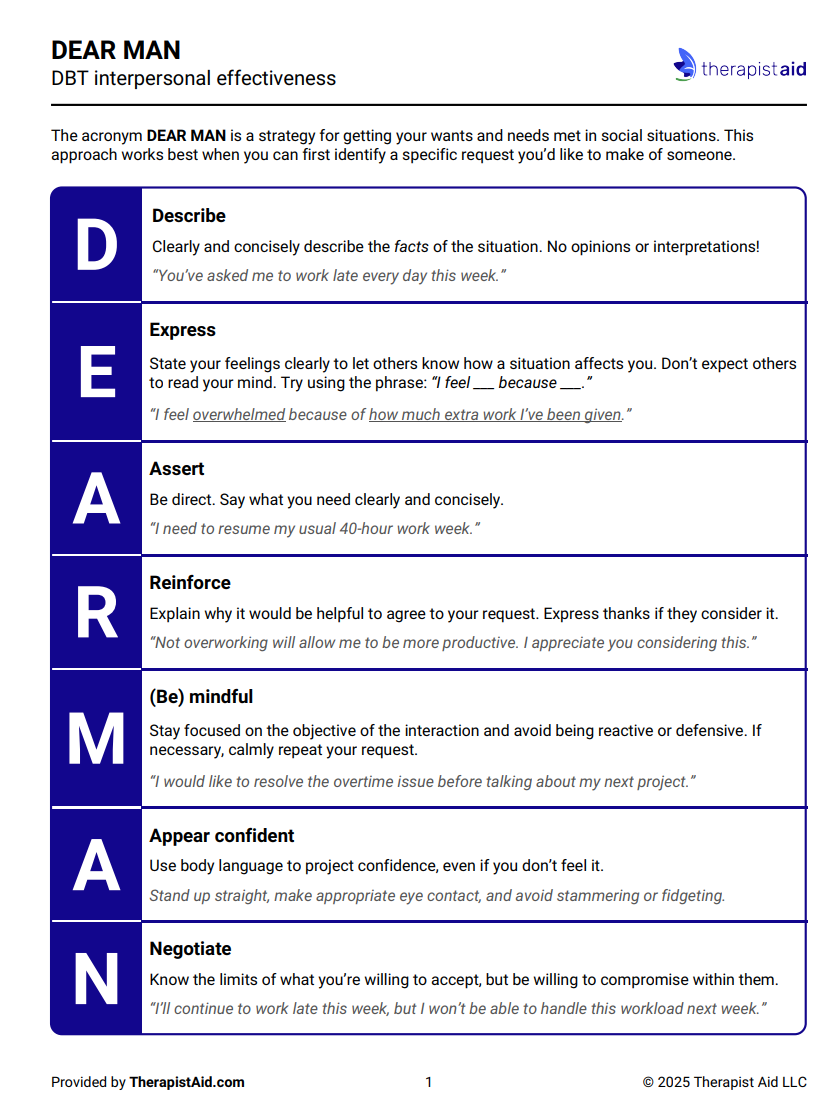
Marsha Linehan's Dialectical Behavior Therapy (DBT) offers a useful model for boundary-setting communication called DEAR MAN — Describe, Express, Assert, Reinforce, stay Mindful, Appear confident, Negotiate.
But before you can communicate a boundary, you need to identify it for yourself, physically and emotionally. Boundaries exist for your protection. They should maintain your mental health — not control someone else's behavior.
Boundaries vs. rigidity. What’s the difference?
Having boundaries isn't the same as avoiding everything uncomfortable. If something is annoying but tolerable, that's not necessarily boundary territory. If coping with something is eroding your mental health over time, that's when it's time to set one.
Real boundaries are about specific situations that occur in your presence. They shouldn't require someone else to take action when you're not around.
For example, these are not boundaries:
"I'll only visit if you vote for my candidate."
"I won't be friends with you if you're friends with her."
"I'll come to the party if you apologize."
These are boundaries:
"I'll come to your house for dinner, just not the night before I have to work."
"I'd like to come to the seder, but I won't stay silent if the family starts arguing about politics."
"I'd like to meet at the park instead."
"My name is _________." (Yes — this counts. Insisting on being addressed correctly is a boundary.)
Frequently Asked Questions about Boundaries in Family Relationships
How can I handle a controlling or overinvolved family member?
A few concrete strategies:
Don't answer the phone or text when you're not available. Don't make exceptions. Consistency is what makes a boundary real.
Respond to threats of self-harm, or statements like "I guess you don't love me," with hotline information rather than getting pulled into reassurance or negotiation. This protects you and takes the situation seriously without making you responsible for managing someone else's crisis.
Disengage from the conversation after you've stated your boundary. You don't have to keep explaining or defending it.
DEAR MAN is useful here too — especially statements that acknowledge the other person's concern while clearly keeping you in charge of your own decisions:
"Thanks for your concern. I can tell you really care."
"I've got this. Thanks for your help."
"I appreciate the information. I'll take it from here."
"I'll bring your input to my medical team and see what they think."
"I need you to trust me to handle this."
"I'm happy with the approach I'm taking. I'll try something else if this doesn't work out."
Is it healthy to tell my family how they've hurt me?
It depends what you're using it for. A conversation about the past is most useful as support for a request in the present — not as an accusation or a standalone statement of blame.
Compare these two:
"Your criticism gave me an eating disorder." — This is an accusation with nowhere to go.
"When you used to criticize what I was eating, it made me anxious about food. I'm working on changing that, and I really need you to not comment on what I'm eating." — This gives the other person a specific, actionable present-day request.
A present-focused version of naming past hurt might simply be: "I need you to understand that hurt me." It's generally not helpful to bring up the same past hurt repeatedly. If you don't get the response you'd hoped for, it's often more effective — and less costly to your own wellbeing — to let go and move on than to keep pressing for acknowledgment you may never receive.
This is a place where Radical Acceptance can be a genuinely powerful tool. Radical acceptance doesn't mean approving of what happened or pretending it didn't hurt — it means acknowledging reality as it is, rather than continuing to fight against a version of your family member's response that isn't coming. That acceptance is often what frees people up to focus on what they can control: their own present-day requests, boundaries, and choices.
Is it okay not to let family stay in my home when they visit?
Absolutely. If you need space to retreat to while family is visiting, say so. If it would make the visit financially unworkable for them to stay elsewhere, consider offering to travel to them instead. Your home is allowed to remain a space where you feel regulated and in control.
Have a question that you wish we had answered? Send it to us here. We’ll add your answer to this blog within the coming week!
Can estranged family members reconnect and heal?
As covered above — often, yes. Consulting a family therapist or your own individual therapist can be a genuinely helpful step toward reconciliation, and the DEAR MAN framework applies here too: it's a useful structure for the first outreach message, for proposing a first meeting, and for negotiating the practical terms of rebuilding contact (how often, what topics are off-limits, what pace feels safe). The harder, more emotionally loaded repair conversation itself often benefits more from radical acceptance and validation than from assertiveness scripts alone — which is where working with a therapist, individually or as a family, tends to make the biggest difference.
You Don't Have to Navigate This Alone
Whether you're an autistic adult weighing distance from a family that's struggled to accept you, a parent trying to understand what went wrong with an adult child, or anywhere in between — estrangement and reconciliation are heavy, complicated processes. Our team offers Neurodiversity Affirming Therapy in Bethesda, MD and Counseling in Silver Spring for individuals and families navigating exactly this kind of rupture and repair, with an approach that never asks anyone to mask who they are in order to belong.
Reach out to learn more about our Neurodiversity Affirming Therapy services, or contact us to talk about family therapy for your specific situation.

Robin Brannan is an expert neurodiversity affirming family therapist who has been helping neuroexceptional families thrive for over twenty five years. She guides parents, children, individual adults, and partners in connecting with each other, healing from past misunderstandings, and using their strengths to build the life they want. Her work is playful, culturally responsive, and designed to bring joy to you and your family. She directly supervises every therapist on the team at Better Together Family Therapy, and her commitment to high quality culturally responsive care is clearly reflected in this team.
Explore her specialties including Neurodiversity Affirming Therapy, LGBTQIA+ Affirming Therapy, and Child and Family Therapy. Learn more about her approach on her About page.
