
How Anxiety Shows Up, In You and in Your Family: A Casual Chat Between Therapists
Join expert anxiety therapists Beth Charbonneau LCSW-C and Robin Brannan LCMFT for a casual chat about anxiety. Learn how we treat anxiety in individual adults and in neurocomplex families.
I often say that the best thing about being a therapist is having therapist friends. This is absolutely true. Having friends that know what to say when life is rough is an incredible gift.
And the other half of that gift is the constant deep conversation about life. We therapists aren’t big fans of small talk. When we get together, we geek out about life, love, and mental health. So come join us as we hang out and discuss what it means to be an anxiety therapist. We talk about who we love to work with, what gets in the way of success in anxiety therapy, and so much more!
During our chat, Beth Charbonneau explains so beautifully how anxiety therapy works when she says
“There are ways in which we can work with [anxiety] to help you find more ease, more confidence, and a better way forward. But there's nothing broken or wrong with somebody who has some of these heightened systems going on. It makes a whole lot of sense from an evolutionary point of view, from a nervous system point of view.
And the wonderful thing is sometimes when we get into some of the things that makes anxiety such a challenge, we can figure out how we use those exact same things for good… a lot of people with anxiety have really amazing skills at visualizations, but they end up using that to visualize things going wrong. But the fact that they're so good at visualizing things can then be one of the great tools that we can use with some of the practices that we can engage in to help them find a more hopeful way forward.”
Find Beth’s blog about our chat here.
Full transcript of video, Expert Maryland Anxiety Therapists Chat About Anxiety:
Robin Brannan: Hi, I'm Robin Brannan LCMFT. I'm a Licensed Clinical Marriage and Family Therapist and the owner and Director of Better Together Family Therapy in Kensington. We provide neurodiversity affirming and LGBTQIA plus affirming care for kids, adults, teens, and families, including couples work.
And I am hanging out today with Beth Charbonneau, who is an anxiety therapist that we love to chat with. And we're just going to chat with each other about anxiety. Beth, do you want to introduce yourself?
Beth Charbonneau: Sure. My name is Beth Charbonneau and I am a therapist in College Park, Maryland. I see folks in my office here and online in Maryland. (Find her at www.bethcharbonneau.com)
I specialize in anxiety disorders. I see all the worriers, overthinkers, ruminators, all that good stuff. And I'm excited to chat with my good friend, Robin, who I know as a colleague and a friend and a fellow parent.
RB: Awesome. It's so much fun when we can get together as therapists and just talk about how we see things and do the deep thinking that we do on a regular basis anyway, but do it with each other.
BC: Absolutely.
RB: Love that.
BC: There's no end of things we could chat about with anxiety. It shows up so much. I don't know if it shows up so much in your place, but it's all the time over here.
RB: By my place, do you mean my house? It shows up in both places, right?
So I think one of the things that we have in common when we think about anxiety is that we're thinking about the bodily pieces of how anxiety shows up, not just the mental pieces. We often diagnose anxiety disorders based on someone's thinking patterns, right, meaning we diagnose if we're seeing the worry thoughts come up regularly. That makes it really interesting to diagnose in young kids where they don't monitor their own thinking in quite the same way.
BC: But we're often diagnosing based on thinking patterns, but anxiety is really happening in the body, not just- It's happening in the whole life.
It's happening in the body, the mind, the nervous system, the relationships that we have. Yeah, it's a whole lot of things.

Click to read about body based strategies for nervous system regulation.
RB: Absolutely. Well, I know you do some cool things with that. Can you talk a little bit about how different modalities come in when you're working with anxious adults?
BC: Sure, because anxiety is kind of this whole life process, I feel like it's really important to get a whole life approach to it. So again, yes, we wanna work with the thoughts and the worries in the mind, but we don't stop there. And oftentimes I find that it's a much more effective way in through the body because the mind is so busy being anxious, it's kind of preoccupied with its anxiety.
And the parts that we want that are like the most nuanced thinking, they're kind of offline. They're not so much present when somebody's knee deep in their anxiety. So sometimes kind of coming up through the body can be a really helpful way to get a foothold in walking back that anxiety that's crept up on it.
So I do a lot of work around kind of mindfulness and emotional self-regulation that happens through the body, whether it's using the breath, whether it's using specific skills in terms of like finding relaxation in the body, being able to tune in and being aware about what's happening in the body and getting the accurate information that we need to say, okay, well, here's a place to really start looking at and focusing on. So I find that that's actually a much more kind of useful way in instead of just trying to go straight to the thinking part. Does that show up for you as well?
RB: Definitely. I think, you know, thinking patterns are really well rehearsed. We tend to think in the same loops over and over and over again, especially when we're anxious.
And so, you know, when you engage just verbally and there isn't a body-based piece there, you get that loop. And sometimes that's really helpful because it gives you an opportunity to disrupt that loop, to change that loop, to reshape it a little bit. But a lot of times we find that we have to do exactly what you're talking about.
Anxiety Therapy for Neurodiverse Families in Maryland: What to Expect
We have to find, first, especially with our neurodivergent clients, we have to figure out whether their interoception is there, that sense of internal body process. Some of us feel what's happening inside of our body a lot more acutely than others. And sometimes when you're someone who feels it very intensely, you learn to shut it off for your own self-protection.
And so there's a block there between what the body is doing and what you notice the body is doing. So sometimes we have an extra step of sort of breaking down that block and helping somebody to feel a little bit at a time and then go back to where they feel safe.
You know, other times we have folks that really don't have great interoception in the first place, but that sense of self is not, or that sense of internal body process, really, because sense of self can be a whole lot of things, is not as strong. It's not as clear. It's not something that that person is attuned to.
And sometimes we have to build that connection even to just noticing, you know, when you move your finger, just feel that, right? What does that feel like? Sometimes we have to start really at that basic level and work up to being able to sense our own breathing and our own heart rate and some of the things that we might do as a foundation to mindfulness activities. So for us, there's often an extra step there just because we are working so much with a neurodivergent population and folks have a very particular relationship to their body sensations.
BC: Absolutely, absolutely. Yeah, that's an interesting step there to take with it, even within kind of the continuum of people and their abilities to be able to feel into their bodies. Right?
Yeah, there's a lot of people that I see that are just kind of like very much living from the neck up. You know, they know what's going on in their thoughts really easily, but they might not be at all in touch with what's happening in their body. So yeah, there's a real continuum.
RB: Yeah, absolutely.
BC: But the great thing is, you know, you're pointing out that no matter where you are in the continuum, there is a place for us to kind of start with this and kind of help people kind of get into their full experience about what's going on in their body and their nervous system, in their mind altogether.
RB: Exactly, yeah. There's always a way in.
There's always a way in and, you know, we all could use more practice on up-regulating and down-regulating when we need to, meaning activating our attention when we need to and activating our self-soothing, our calming, our relaxation when we need to.
BC: Everybody, everybody can do that. Not even, not just folks with anxiety issues, but like we could all use that. And, you know, I know you work with a lot of families and that's like such an important thing about parenting and family life, like being able to model that and teach that to kids, you know?
So that's a great thing for everybody to be working on. I know oftentimes when I'm working with anxious adults who are parents, they are concerned about, you know, making sure that they, they don't wanna pass on their anxious habits to their kids. They wanna kind of be able to do right by them by kind of modeling what they're learning.
And what I find really interesting is though, even though they want that, sometimes they're hesitant to really bring it into family life, you know, in terms of really showing what it looks like to do some emotional self-regulation when you are starting to feel off. And it's one of those things that, you know, we talk about being like a real gift to your kids, whether your kids are more on the anxious side or not on the anxious side, you know, being able to like fully model and show like, hey, like I'm feeling kind of a little bit, a little bit jittery right now. I think I'm gonna take some really nice, slow, deep breaths and just kind of imagine that I buy a beautiful waterfall with the sunlight on me and modeling that like out loud for children.
And sometimes it can be a little self-conscious for people to get going with it. But oftentimes I hear that when they do do that, it really is something that's kind of fun and enjoyable as a family.
RB: Yeah, absolutely. Slowing down enough to do that as a family can be really hard to do. But, you know, parenting itself is a bringer of anxiety into a system, right?
I mean, you have this person who you love so deeply and you're fully devoted to caring for and the best life possible and you have very little control over their experience.
BC: No, and you want the best for them and it can, yeah, bring up all kinds of things.
RB: It brings a lot of anxiety. I think even parents who don't experience anxiety in other contexts absolutely experience anxiety when it comes to parenting, right? And sometimes, you know, sometimes that need to protect gets a little bit too big.
It gets a little bit hard to trust that our kids can handle something on their own. And when that starts to happen and family life starts to get shaped around that anxiety, we start to do or not do things or build in extra time because we know that someone is anxious about something in the family. We have an approach that we use to reverse that called SPACE, Supportive Parenting for Anxious Childhood Emotions.
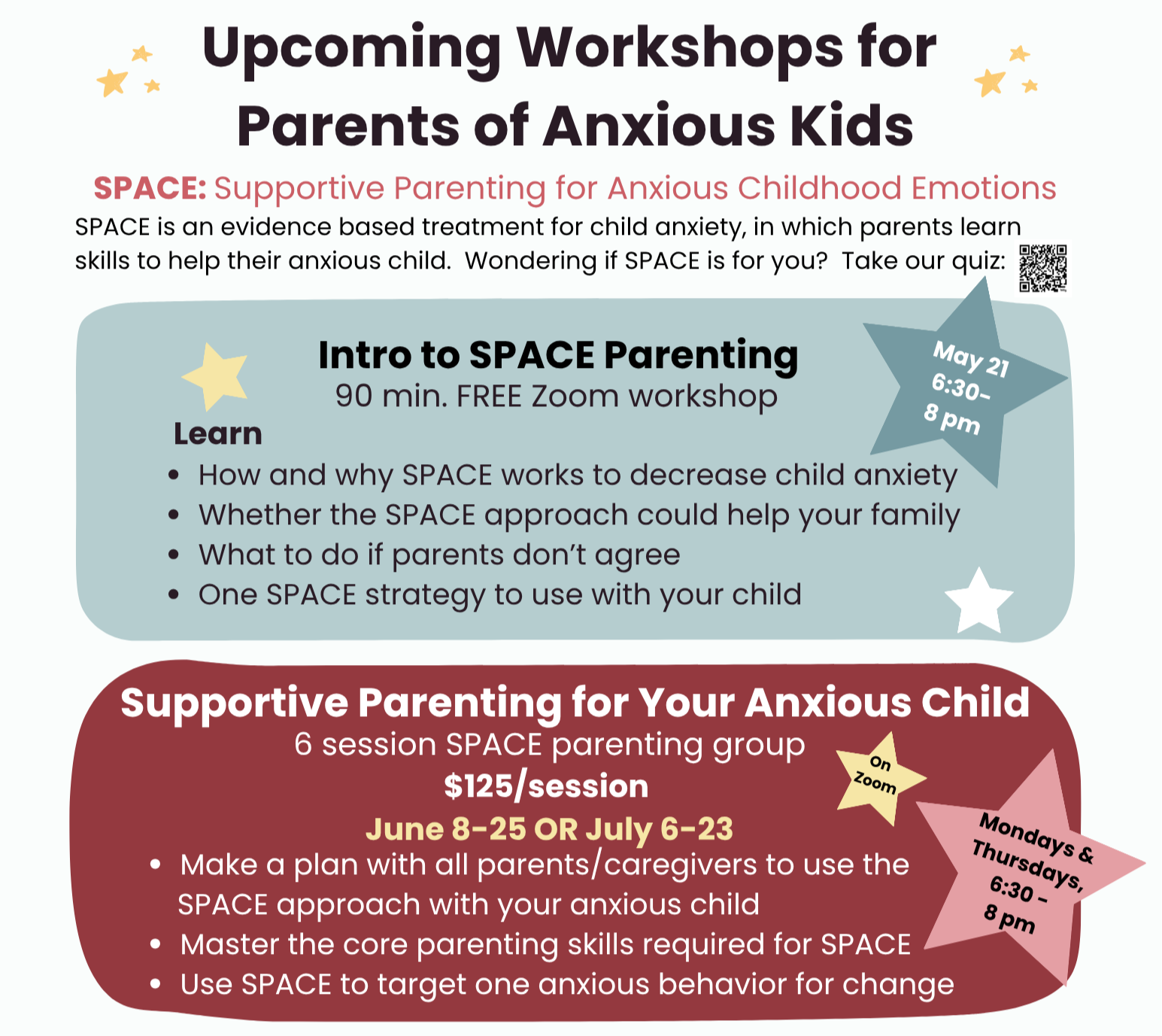
Yeah, SPACE is amazing. It is an evidence-based practice for treating child anxiety. But the really cool thing about it is that you're treating child anxiety in the family system, not within the individual child. And so that appeals to me as a family therapist. Everything I do is systemic. My lens is systemic even if I only have one person in front of me.
But what SPACE does is teach parents a very specific way of responding to their child's anxiety that decreases the child's anxiety over time. And the way that it decreases the child's anxiety over time is by building the child's awareness that they can handle feeling uncomfortable, that it's okay. Absolutely, it's scary to go into a new classroom.
It's scary to go into a new activity.
There are many, many moments where you're going to feel that level of anxiety that isn't pathological, right? It isn't clinical anxiety. It's the anxiety we all feel in a difficult situation. But oftentimes when kids are experiencing a clinical level of anxiety, it's hard for them to tell the difference. And so it starts to feel like all situations are unsafe.
And so building that understanding within the child that they can handle feeling uncomfortable. They can still do things when they feel uncomfortable. And then they see themselves do that and that builds their confidence over time.
What's challenging about doing it that way is parents have to trust that what they're doing is going to have an impact over time, right? It's not an instantaneous thing where we have all these behavioral approaches that we take sticker charts and timeouts and things like that, that you expect to see instant results from, right? You expect to change immediately from that.
SPACE is not that. You don't get the change the minute you do it. You have to invest in it over time.
And that's a hard thing to do.
BC: It is. And I would imagine that part of the investment is that the parents also have to like hold on to their own worries and anxieties or their own reactions better. Because if you're not kind of giving into an avoidance, like, oh, we don't have to go do that, the child might not be really happy about that.
They might be even more activated, which means the parent then has to kind of hold on to what happens within them when their child is activated or upset or having a meltdown, right? So it sounds like that's part of this too, is like it's not just about kind of dealing with the pitfall of avoidance on the child's side, but also the parents as well.
RB: Yes, absolutely. Absolutely. And that's where it really makes a difference for everybody in the family, right?
It's technically not treating anxiety in the parent, but the parent is having to respond differently to their own anxiety. When your child is screaming “I can't do this” you want to believe them and rescue them from that situation. What they're really screaming is “I don't believe I can do this.”
BC: Yeah.
RB: And then as the parent, you have to demonstrate that you do believe that they can do it. And that's really tough to do in that moment.
BC: It is, but again, it goes beyond the thinking thing, because a parent can say, oh, I do believe in my child, but if their nervous system is firing in a way that says like, no, no, no, no, no, no, no, no. Like that's a different story. It's not just about also kind of having that thought of like, oh, I believe my kid can do this.
It's also being able to inhabit a nervous system that says like, we can manage this.
RB: Yes.
BC: Right?
RB: Yes, because your child is not just getting signals from your words. Your child is getting signals from your body.
BC: Right.
RB: Yes. Yeah, and a lot of the work in space is around handling that from the beginning so that when you're starting to implement things with your child, you have a really clear plan and you know how you're going to handle it when things come up within you, right? There's a lot of planning on the front end to implement very carefully and methodically.
BC: I bet it's really helpful to feel like there is a structure there that kind of like a container that holds this process that says like, okay, we get that this is a real thing and here's a structure. Here's our container that can hold it and allow you to work within it and find a better way forward.
RB: Absolutely. Absolutely. And I think one of the lovely things about SPACE is that you're targeting a specific situation when you go through it, at least when you go through it for the first time, because once you learn it as a parent, you can repeat it with all kinds of other situations.
But you're targeting one particular action, what's called an accommodation, which is different than the accommodations you'd have on an IEP. Accommodation is when the family changes other people’s behavior in response to child anxiety.
The family changes the whole system's behavior. And so you're targeting one specific accommodation that you're making and you're changing that one specific accommodation.
And then if you want to change something else, you can go after that something else with the same tools. But at first SPACE gives you something very clear that you're working to change. And part of working to change one specific thing is accepting that the other things are not going to change in that moment.
Right? It's like, for right now, this is our target.
BC: Yeah.
RB: And we're going to let go of all the other pieces. We're not going to try to fix everything at once.
BC: Because that never works.
RB: It doesn't work, but even as therapist parents, we try it anyway.
Change comes one step at a time
BC: I know, and it's not even just in parenting. There's this tendency to kind of want to do the whole full life makeover, right? I'm going to get up every morning and I'm going to make sure I do my meditation and then I'm going to go for the run.
And then I'm going to write that.
RB: I'm also going to drink enough water and I'm going to get all my work done. Right.
BC: Yeah, I'm not going to put all those things in my little planner. And so there is that temptation of wanting to think I'm going to have the transformation complete experience. Yeah, definitely.
I'm sure you're noticing and why you kind of do a targeted one thing at a time approach is that when we try to do this like full life approach, it always fails. And then we're back feeling like we're frustrated, nothing ever changes, right? And it's just too much for a system to handle.
RB: Yeah, absolutely. And I think as parents, we're always observing many different things that we want to shape in our kids. Oh, I'm going to make sure they do their homework and they clean their room and all the things.
We see all the things every day. And it's very hard not to intervene in all the things.
BC: Yeah.
RB: I think we're learning a life lesson probably in that right now because we both have college freshmen who have come home for the summer and now we have to figure out how to be less involved.
It's a journey for us too. Every single day.
BC: But it's great because it gives us ways of being able to work on a lot of the things that we work on with our clients in our own lives in real time. And so, it's kind of one of the worst things about being a therapist. You can't be like, well, I don't know what to do.
I'm like, no, I know what to do. I just don't know what to do. Maybe I just don't want to.
Yes. Yeah.
Turning Intention into Action with Neurodiverse Clients of All Ages
RB: Absolutely. Okay, what else? What else should we talk about here when it comes to anxiety in adults and some of those parallels that come up in families?
BC: You know, one of the things that I think is so great about probably working with kids is that you're often in the action piece. You know that things, you have to do things differently, right? I think one of the challenges in trying to get a little bit of this concept across to adults is sometimes, sometimes there's this idea among the adults that work with it, like if they just kind of understand something in a certain way, it's going to change.
Right? And so, it's kind of like the insight piece of it. And insight is so important, like understanding why this kind of comes up for you.
What about it bothers you? Like what's going on about it? It's all really important.
But I think that there can be, among a lot of the adults that I work with, some surprise around the idea of like, oh yes, but now we have to have the action piece. Like we have to do things differently. Right?
So, you know, insight without action does not lead to change. And so, I imagine that kind of like working with kids, there's often like an explicit understanding that there's an action piece to this, that we have to do things differently. But we also have to have the insight piece because we can't just do things randomly differently and not know why this worked or didn't work.
Right? You know, so I wonder if it's kind of like maybe a little bit flipped and reversed on your end of it, where there's more of a ready-made action kind of orientation with the kiddos.
RB: That's an interesting question. I think we do a lot more experientially in the moment with kids. Sometimes with adults, it's tempting to talk about what we're going to do and not do what we're going to do, not do the sort of behavioral rehearsal piece in the moment.
Why parent involvement is essential in child therapy
And so with kids, we definitely are more action oriented in the room, but a lot of child therapy happens without parent involvement. And I agree 100% with what you're saying that the action has to happen, but that six or seven year old is not going to go home and take those actions on a daily basis for a week without somebody else monitoring and supporting that. Right?
That's a huge piece of why we need, want, expect parent involvement in child therapy. Because if you don't know what your child is working on, you can't support it. And if you can't support it, it's not going to happen, at least not at the pace that you want it to happen.
You don't want to have to wait for development in order to kind of take a step forward. Right? So the parent piece is so important there.
And I think, you know, as a family therapist, it's really clear to me that there are ways to balance a child's confidentiality and privacy when they're sharing things in the therapy room without their parent present and then parent is present for some of it. There are ways to balance that collaboration with the family and the child's privacy and confidentiality. I think for a lot of therapists who are trained only in an individual model, those things feel mutually exclusive.
It feels impossible to maintain a child client's confidentiality and really truly loop the parent in. And I just don't think that's true. I think we're asking constantly for informed consent from a child to share things with a parent or sharing things with a parent transparently in front of child so that it's very clear what's being shared and what's not being shared.
But those conversations are so essential. And at the end of the day, every child client I've ever met wants to be better understood by their parent, right? That is a goal in every single child therapy case.
You want that relationship to be more solid than it was coming in the door. And you don't get the relational benefit when you just work one-on-one with the child and say, okay, this is confidential parent, stay out there.
BETH: Yeah, no, for sure. And there's a reason why people are showing up in our offices too. They obviously want something to be different, right?
We're fun people to hang out with, but they're not coming to just hang out with us. They're coming because they've recognized that something isn't working well in their life or in their family. And they really do want it to be different, which means that they're gonna have to kind of do some of these things, whether it's kind of be patient and put in the time and the effort and the investment of the work, or kind of like build those relationships and trust or practice the skill and take action when they need to.
So there's a reason they're there.
Neurodivergence and Teaching Emotion Regulation
RB: Yeah, absolutely. And then I think there's also an additional piece there when it comes to neurodivergence. We often, we think of neurodiversity affirming therapy as being affirming of the person in the room, but it is not just that.
It's full acknowledgement of the needs of that person and the other members of the family in the conversation. And part of acknowledging those needs is doing enough planning for the action steps that happen in between sessions. Intention is not enough to create action.
It has to be very clearly mapped out. How is this going to happen? How's everybody going to support this happening?
When is it going to happen? Can we put it on the calendar? Can we set the reminders?
Can we do all the things that are going to set you up to be able to take action in your real world day-to-day context so that you don't come back to therapy next week feeling like you've failed in some way. Because if we walk out of the room with intention and we come back to the room the next week not having met that intention, that feels like failure. Even though there are legitimate reasons for it, it feels like failure.
And the last thing we want to do with our neurodivergent clients is have them have repeated experiences of failure. They're already feeling like they're failing in certain areas. And we can't be piling on that.
So we have to be able to do that planning piece, providing that scaffolding, providing that support. That's where we use the word accommodation as something that we want to add rather than subtract, right? We are accommodating the particular neurotypes we have in the room to see how something gets done between these particular people, not just how something gets done theoretically by the textbook.
BC: Yeah, it's looking at that bigger picture.
RB: Yeah, definitely.
The value of failure as a learning experience
BC: Whereas, and it's keeping in mind like what the downstream effects are. Like you were saying, kind of like this idea of like you don't want that experience of these repeated kind of failure experiences because that's already something that's kind of often happening in this person's life already. Yeah.
Which is sometimes a little different than from an adult individual point of view where I'm maybe not working with that point of view as much. Where sometimes the failure is instructive if it doesn't happen. If something, if we have a plan and a client does follow through with something, sometimes the failure of that is just as instructive as the success of it.
And can sometimes also provide kind of like an interesting way of kind of saying, well, what is that like for you? So, but it just depends on kind of like where the needs are of that particular client or family and what inner resources they have, what their external resourcing looks like. So it's not one size fits all.
It's being able to meet the need of whichever client is or family is with you.
RB: Yeah.
BC: And that all of them are going to require different levels of support or accommodation or consideration or all of those things.
Why your therapist WANTS your feedback
RB: I wonder if the general public that doesn't participate in therapy on a regular basis understands how much adaptation is done there on the part of the therapist. This is a two-way relationship. You're not coming in the door and getting, well, here's the first session worksheet and here's the second session worksheet. It's a very, very tailored approach.
And that also means that if something's not working, if it's not moving forward in the way that that client wants it to move forward, then it may not be the right fit relationship. And so sometimes I think when clients have a lot of anxiety and they come in the door, that one of the biggest fears is this won't help me. And then I have to cross therapy off the list of things that could help me. And it's very scary. Even though we try so hard not to be scary people, it's very scary to say to your therapist, this isn't working for me.
BC: Yeah.
RB: I just want to validate for people that that conversation is so important. Like sometimes that is the clinical success that we have with a client, that that client was brave enough to say, this isn't the right approach for me.
BC: Right, right. And the thing is, we're not mind readers. So we can pick up on a lot of things, but we're not mind readers.
And so if we don't get that information and that feedback, we can't help support someone, whether that's trying to change an approach, try something new, or make a referral for someone who's a better fit based on whatever the client's needs are. Yeah. We aren't mind readers, and so, yes, it is hard to say that.
It's hard for me to tell my hairdresser I want something different sometimes.
RB: Yeah. Right? Absolutely.
BC: But we, you know, so if somebody doesn't know that we want that feedback, we can tell them right now, yes, we want that feedback. We actually really appreciate that, and it helps us do our job better to help provide you with whatever supports that you need, even if it's not with us, because we do want the best for you. We want your success, whether it's with us or with somebody else.
RB: Yes, absolutely, and when it's not working, it's no fun for us either. We like to move forward in therapy, too.
BC: Absolutely, and there are people that we work better with and we work less well with, right, you know, and which is why I think, you know, we develop kind of the specialties that we work with, the things that we concentrate on, because we know, oh, like, this is what I do well, right? This is who I serve really, really well, right? Because we can't do everything for everyone. We can't be a specialist in everything because- Definitely. It just dilutes our process. Yeah.
Who we serve best as anxiety therapists in Maryland- online or in person
RB: Who is that for you, Beth? When you think about the person that you serve really, really well, who is that person?
BC: So it's somebody who really wants more out of their life than their anxiety has been letting them have thus far. You know, whether it's they want to feel better in their body, in their mind, in their relationships, but their anxiety has been in the way for so long. And most of the time, this person is also somebody who has tried the things before.
They have tried the app. They have tried the this. They have tried the that.
But what they really need is somebody to really get in there with them to help them move forward and do this piece of both understanding what's happening and finding action ways to move forward and really kind of move with them through that process. So the person that would be a good fit for me is also somebody who's willing to maybe try some new things because it's not just about, like you said, worksheets and those kinds of things, but could we kind of explore a little bit about what is happening in your body? Would you be willing to try a breathing exercise? Would you be willing to try something new? You know, I've got everything from I've done training in yoga therapy and I'm a clinical hypnotherapist as well. So like I've got this big, giant toolbox that I would love to be able to offer people.
And I think people who are willing to kind of be like, oh, let me see what's in your toolbox. I want to see all what you've got is a good fit for me. I love that curiosity element.
RB: Yeah. Like, let me see what's in the toolbox. I'm just picturing this enormous, big, huge…
BC: I can't pick it up. It's so big. It's so big.
RB: It's so big.
BC: Who is that for you?
RB: You know, for us, because I have a group practice and there are six of us in the practice, everybody has their own people that they really work best with. But I think for us families where they are struggling to figure out the cross communication between parents and kids, between parenting partners, within a couple, wherever things are breaking down between people, that is where we really do our best work.
And we see a lot of that sort of breakdown happening when families have neurodivergent children in particular, because it takes a long time to figure out what's going on. And so parents and kids misunderstand each other and misunderstand each other and misunderstand each other for… typically a period of years… before they finally get some understanding of, “oh, this is why this piece isn't working for us the way the book said it would work.”
And so families who are at that point of figuring out, “oh, we've been not getting each other and now we really want to get each other. So we want a therapy practice that's going to talk to us about why this went sideways and make sure that we're rebuilding our relationship in the process.”
Because that all of that harm that's been done to the relationship is nobody's fault. It brings a lot of guilt for parents, but it's really, truly not a parent's fault. And it needs to be healed in the process of therapy.
Yes, we can do things differently from this point forward, but also we need to give each other a little extra love to recover from what we've all been through together. So families that are really at that point, like that, that's our sweet spot.
Healing family relationships with anxiety therapy
BC: And, you know, you mentioned this really important thing about sometimes it goes on for years before, you know, a family reaches out to get some support, get some assistance. Right. Almost always.
RB: Yeah. Right. I mean, kids are not typically diagnosed in infancy. So sometimes, you know, sometimes you have a parent who has their own ADHD diagnosis, their own autism diagnosis, had their own learning differences growing up. And so they're coming at it from a neurodiversity affirming lens. But coming to understand what their particular child needs and what works for their particular child is still a years-long process.
BC: And like you said, over those years where families are struggling a lot, build. So if, if there was, if there was somebody in a family who was watching this, who has been in this like long struggle or process and it's been building for years, like what's the one thing you'd really want them to hear today?
RB: That it can be different. I think that's probably universal for us as therapists, but just that it actually can be different. That you can have an experience in therapy that you enjoy.
I used to say when I was a solo practitioner… the tagline on my website was “therapy should be fun.” Obviously it's not always fun, but therapy should be multisensory. Therapy should be engaging.
You should come out of a therapy session feeling like you've done something a little differently than you did it at home. And that can be such a good feeling. We have to watch out for the guilt that comes from the parents' anxiety in that moment, right? Because as soon as we do it differently, we're like, oh, there was a better way to do this.
As soon as we know there was a better way, we are hard on ourselves about not having found it sooner. “Why didn't I know?” That’s the very next thing that happens. So we have to watch out for that and put up the stop sign for that in the moment.
But just knowing that it can get so much better and you're resilient and your kids are resilient. We really can bring all of the amazing strengths that everybody in the family has together and make something that works for everybody. That's really lovely.
BC: Yeah, it is really lovely. It's such a great experience to have in the room. Yeah.
We love this work so much. Well, I hope that anybody who needs to hear that gets to hear that and get that sense of hope and be able to imagine something better for themselves. Yeah, absolutely.
RB: And I hope that the people that need your giant toolbox that doesn't even fit in the room can get the tools that they need. Because I do think we need a lot more practitioners that are using all of the senses and using the body more, especially in treating anxiety. But just in building people's mental health and strengthening people's mental wellness in general.
BC: Absolutely. We all need to get out of our heads. Yes.
And without having to feel bad about what it is that we come in with, not just kind of like, why didn't I do things differently, but just about kind of who we are, what we have going on for us. I think I would want anybody who's dealing with anxiety to know that there's nothing wrong with you. This is just part of the human experience.
And there are ways in which we can work with this to help you find more ease, more confidence, and a better way forward. But there's nothing broken or wrong with somebody who has some of these heightened systems going on. It makes a whole lot of sense from an evolutionary point of view, from a nervous system point of view.
And the wonderful thing is sometimes when we get into some of the things that makes anxiety such a challenge, we can figure out how we use those exact same things for good. In terms of a lot of people with anxiety have really amazing skills at visualizations, but they end up using that to visualize things going wrong. But the fact that they're so good at visualizing things can then be one of the great tools that we can use with some of the practices that we can engage in to help them find a more hopeful way forward.
RB: A hundred percent. So how do people find their way to your toolbox?
How to find a good anxiety therapist for adults in Maryland
BC: Probably through my website is the easiest way to find me, www.BethCharbonneau.com. And there you can kind of find information about my specialty stuff around anxiety, but also mindfulness-based treatment approaches, including some Buddhist psychology and clinical hypnotherapy, which can be used within any of these approaches or separate from it. So that's the best way to find me and there's a contact button and you can reach out and ask questions. And how do people find you?
Anxiety Therapy for Children and Families in Bethesda, MD
RB: Our practice name is Better Together Family Therapy, but we decided that was too long for a URL. So we are www.betterfamilytherapy.com. And same, we've got a contact button. We've got an appointment request button.
Just reach out. We're happy to answer questions. One of the clinicians on our team also serves as our Client Care Coordinator, our first point of contact. So when you're talking to somebody in that initial phone call, you are talking to somebody who is also a licensed therapist who's getting that intake information from you. And so that person can ask you some really good, really thoughtful questions about what you're looking for in a therapist, because with six of us on the team, we want you to find the right person within our team or beyond our team, right? If we are not the right fit, we're going to be really clear about that too and try to make sure that you get handed off to a provider who is.
BC: And that's also the same place to go for people who are looking for SPACE groups too?
RB: Yes, absolutely. I would just start with the home page of the website. We've got a blog about SPACE that's kind of pinned at the bottom. There's a space page in the menu at the top.
So when we're running SPACE groups, they're there. We are actually currently recruiting for our summer 2026 cohort. This is going to get dated really fast, but we have a June 2026 and a July 2026 group coming up.
And the way that we start out the group process is we do a free intro to space workshop that everybody who's going to participate in the group comes to, but then anybody else can also come to that free intro workshop so that you get all the information. That's actually happening next week. That's happening on May 21st at 6:30 on Zoom.
So you can register for that on the website as well and just come to the intro workshop, learn kind of the basics of the SPACE approach, what it is, who it's for, decide if it feels like it's something that your family wants to take on right now or not. We do do SPACE one-to-one also. So if you wanted to do the SPACE approach individually and just come in and meet with a therapist yourself, if group is not your thing, you can absolutely do that.
We usually have three to six families in a group. So it's a very small group environment in which people are learning SPACE together. Thanks for the reminder to bring that up.
BC: No problem. I hope people can use that can find their way to you. It's been so nice to chat. Thank you for spending the time with me today.
RB: Yeah. Thank you.

Robin Brannan is an expert neurodiversity affirming family therapist who has been helping neuroexceptional families thrive for over twenty five years. She guides parents, children, individual adults, and partners in connecting with each other, healing from past misunderstandings, and using their strengths to build the life they want. Her work is playful, culturally responsive, and designed to bring joy to you and your family. She directly supervises every therapist on the team at Better Together Family Therapy, and her commitment to high quality culturally responsive care is clearly reflected in this team.
Explore her specialties including Neurodiversity Affirming Therapy, LGBTQIA+ Affirming Therapy, and Child and Family Therapy. Learn more about my approach on my About page.
